Fine Needle Aspiration Cytology in Pune (FNAC)
Fine Needle Aspiration Cytology in Pune (FNAC), a safe and minimally invasive diagnostic test performed by Dr Abhishek Bairy, Interventional Radiologist. FNAC helps evaluate thyroid nodules, breast lumps, and other swellings with precision, offering quick results and guiding effective treatment.
Dr Abhishek Bairy
1/14/20261 min read
What is an FNAC?
Where may you come across this term?
FNAC is a quick and simple procedure to check any abnormal lumps or swellings. It helps doctors find out what’s going on—what the swelling actually means.
Here are some FAQ’s which may help clear some doubts you may have about this procedure.
🩺 What is FNAC?
FNAC stands for Fine Needle Aspiration Cytology.
It is a safe, quick, and low-cost procedure used to check lumps or swellings in the body.
📍 Where is it used?
FNAC is commonly used for:
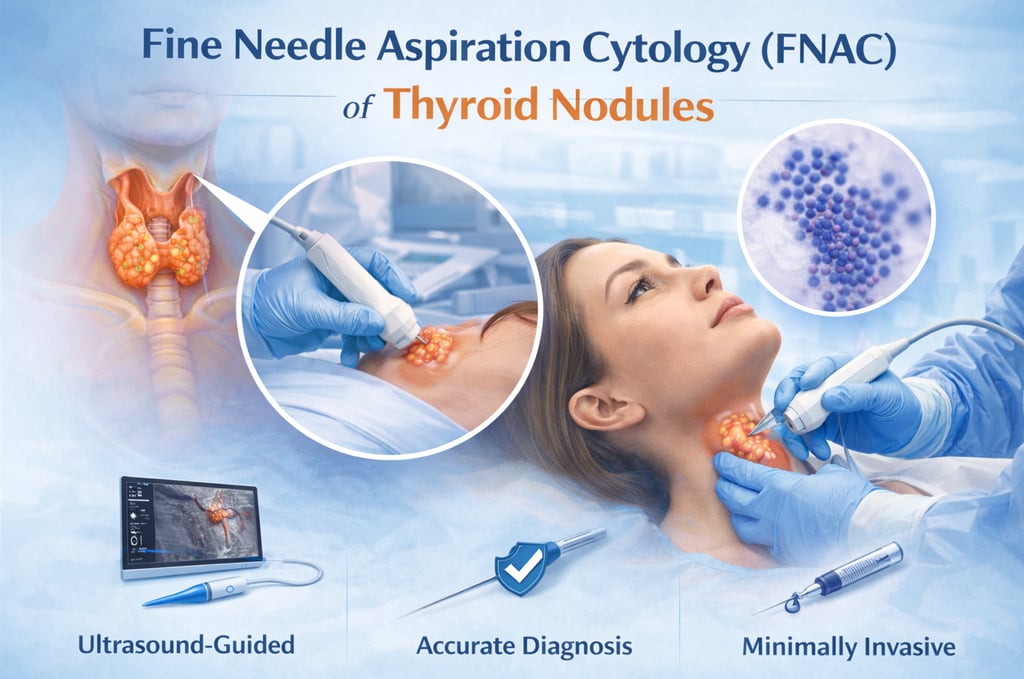
Thyroid nodules
Breast lumps
Lymph nodes
Salivary glands
Other swellings in the neck or body
🧪 How does it work?
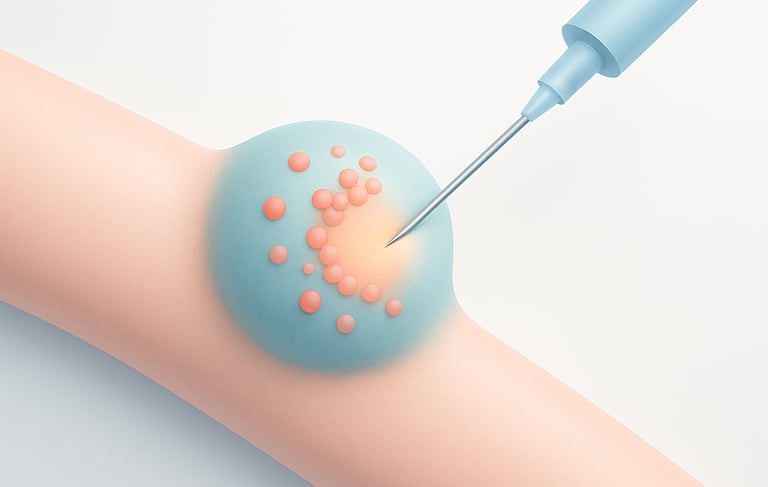
A thin needle is gently inserted into the lump.
The doctor may use the help of ultrasound or may directly perform the procedure depending on the size and location of your lump.
A small sample of cells or fluid is taken.
The sample is sent to a pathology lab and looked at under a microscope.
Who performs this procedure?
· A radiologist or an interventional radiologist commonly performs this procedure using the guidance of an ultrasound.
· Very large lumps may be targeted by the pathologists or surgeons themselves.
Why is it helpful?
No open cuts or incisions
Minimal discomfort
Fast results
Helps detect infections, inflammation, or cancer and guide further treatment
🧘 Is it painful?
Most people feel only a tiny pinch.
There are no major side effects and you can go home right after.
🕒 What to expect
Takes just a few minutes
Done in an outpatient clinic
Results usually come in a few days
If you notice a lump or swelling, FNAC might be the first step to finding answers.
Always talk to your doctor to know if it’s right for you.